
When visibility disappears, safety can disappear with it. Whether it is a firefighter moving through a smoke-filled building, a utility engineer responding to a power outage, or a construction team working overnight, they always need to be highly visible in order to stay safe.
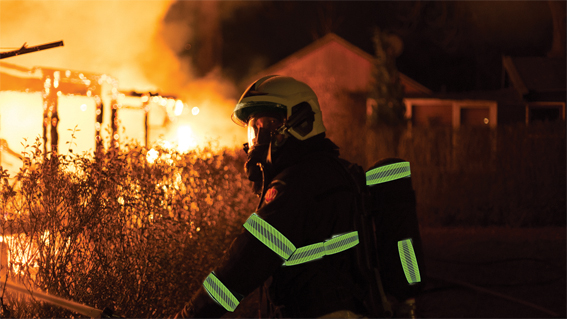 Phosphorescent technology, worn here by a firefighter, offers a fundamentally different approach to enhancing the visibility of its wearers in low-light conditions compared with traditional fluorescent and retro-reflective materials.
Yet many of the high-visibility technologies used today still require external conditions (namely lighting) to be right for them to function effectively. Further, when those conditions change unexpectedly, the effectiveness of traditional systems can be quickly, and significantly, reduced. This is one of the key challenges driving innovation in the development of safety wear today—how to ensure that workers remain visible when sources of light are limited, disrupted or no longer available.
For decades, developers of high-visibility personal protective equipment (PPE) have relied primarily on the use of fluorescent and retro-reflective materials. The widespread adoption of these technologies has played a vital role in improving worker safety, but increasingly complex working environments are exposing their limitations.
Fluorescent materials are highly effective during daylight hours; they make their wearers stand-out visibly from their surroundings. Retro-reflective materials perform well at night, but only when they are illuminated by an external light source, such as the headlights of a vehicle or a torch (flashlight). If there is no visible light available for them to reflect, their effectiveness is significantly reduced.
Further, harsh operating environments can accelerate the wear and tear on fluorescent and retro-reflective materials, reducing their performance over time. In emergency situations where lighting is unpredictable, these limitations can create critical windows of danger, precisely when visibility is needed most.
As a result of the limitations of fluorescent and retro-reflective materials, the PPE industry is moving beyond individual safety features and towards integrated systems that combine multiple layers of protection. The need to be seen in challenging conditions is no longer being treated as a standalone requirement, but as a factor in a broader approach that brings together durability, protection, comfort and performance.
One area attracting increasing attention is phosphorescent technology, which offers a fundamentally different approach to enhancing the visibility of its wearers in low-light conditions.
The science behind continuous visibility
Most people are familiar with glow-in-the-dark materials, but the use of these technologies in professional safety products requires a considerable amount of engineering. The concept itself is straightforward. During the day, or under artificial lighting, engineered phosphorescent materials absorb and store light energy. When the surrounding environment becomes dark, that stored energy is released gradually as a visible afterglow. Unlike reflective systems, which need to be exposed to an external light-source to function, this approach continues working independently of any external factors. As a result, it provides an additional means by which a worker can be detected that remains active even when conventional lighting is unavailable.
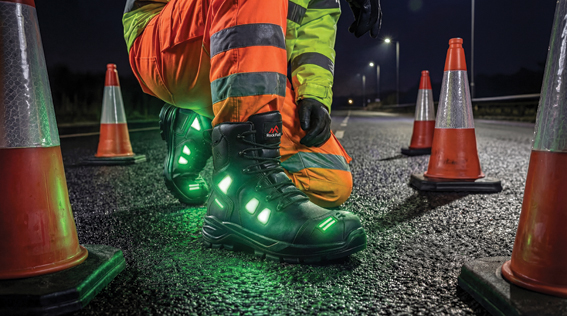 The phosphorescent technology in Signal Lucence Pro, shown here fitted to safety boots, creates a layer of passive protection that continues working even when conventional lighting systems fail.
 The effectiveness of phosphorescent technology depends on several factors, including how efficiently it absorbs light, the brightness of the afterglow it produces, for how long it remains visible and how well it maintains its performance over time. Recent developments in phosphorescent pigments and encapsulation technologies have significantly improved the brightness, charge-efficiency and durability compared with earlier generations of phosphorescent technology.
For safety applications, the consistency with which a material performs is just as important as its brightness. A material must not only perform well when new, but also continue to deliver reliable low-light performance after exposure to real working conditions. For textile applications, there are additional challenges. The material must remain flexible, durable and comfortable while withstanding harsh influences, such as abrasion, weather exposure and repeated cleaning. Achieving this balance requires the expertise of specialists in surface science, polymers, adhesives and textile engineering.
Safety solutions using stored-light technology
These industry challenges are creating opportunities for the developers of high-visibility materials. At Coats, we are using these challenges to help drive innovation. By applying our expertise in materials science and textile integration to modern challenges in industrial applications and PPE, we are exploring how we can transform stored-light technology from a scientific principle into a practical – and effective – safety solution.
One of the areas where we are focused on making this happen is through our Signal Lucence range of high-visibility tapes. Our most recent innovation, Signal Lucence Pro, uses a phosphorescent glow-in-the-dark technology called VizLiteDT to deliver three complementary detection and recognition modes within a single system.
The first mode is based on fluorescent technology, and ensures high visibility during daylight hours. The second is retro-reflective technology, which enhances wearer detection when illuminated by external light sources at night. The third mode is phosphorescent technology, delivering passive illumination when external light sources are unavailable. Integrated into a single tape or trim, these technologies provide a comprehensive safety solution that can be rapidly charged by both natural and artificial light to deliver a long-lasting afterglow—without the need for batteries, wiring or any external power source.
The phosphorescent technology in Signal Lucence Pro creates an additional layer of passive protection that continues working even when conventional lighting systems fail and supports workers across a much wider range of operating conditions—particularly in situations where workers can suddenly become difficult to see. During power outages, in smoke-filled environments or in remote night-time operations, ensuring that workers can be seen can help the identification of colleagues, equipment, routes and exits more quickly. It can also support orientation, recognition and faster decision-making when teams are working under pressure.
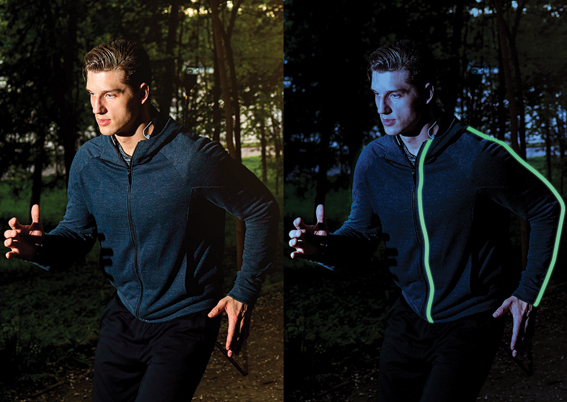 Urban cyclists and endurance athletes competing through the night, and outdoor workers operating in remote locations, could all make use of phosphorescent textile technologies.
 In the UK, our Signal Lucence technology was recently included in the new National Firefighter PPE specification, following extensive evaluations and operational trials across helmets, garments, gloves and boots. Beyond establishing a new benchmark for firefighter safety and recognition in low-light environments in the UK, the specification also provides an important reference point for fire and rescue organisations around the world that are looking to increase the safety of their workers by using next-generation protective technologies. More broadly, the specification reflects a wider industry shift towards integrated safety systems that combine recognition, protection and durability into a single solution.
The future is bright: looking beyond traditional PPE
While safety applications remain our immediate focus, the potential uses for phosphorescent textile technologies extend well beyond traditional protective clothing. Urban cyclists navigating poorly lit streets, endurance athletes competing through the night, and outdoor workers operating in remote locations all face challenges where passive illumination could provide meaningful benefits. The technology also opens-up new opportunities in footwear, sportswear and lifestyle products, where consumers increasingly expect products to combine functionality, safety and design.
The industry is moving towards a future where persistent low-light recognition becomes a standard expectation rather than an optional enhancement. For Coats, that future is not simply about creating brighter materials. It is about applying science and engineering to solve real-world challenges, helping people remain visible, protected and safer wherever their work or activities take them.