
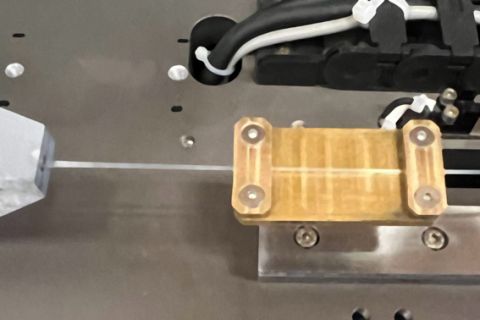
The researchers, from the Massachusetts Institute of Technology (MIT) in Cambridge, USA, have found that fibres made from a common, soft and flexible olefin block copolymer (OBC) are able to conduct almost twice as much heat when stretched quickly as they do when relaxed. This transition occurs within just 0.22 seconds, which is the fastest thermal switching that has been observed in any material.
A Principal Research Scientist at MIT’s Department of Mechanical Engineering, Svetlana Boriskina, says: “We need cheap and abundant materials that can quickly adapt to environmental temperature changes. Now that we have seen this thermal switching, this changes the direction where we can look for and build new adaptive materials.”
The key to the phenomenon is a process known as alignment-induced vibrational delocalisation; when the fibre is stretched, its microstructure aligns in ways that suddenly allow heat to pass through it easily. In the polymer’s unstretched state, the same microstructures are tangled and bunched, effectively blocking the transfer of heat.
Boriskina and her colleagues were looking for more environmentally sustainable alternatives to elastane, and were investigating fibres made from polyethylene (PE). She explains: “Once we started working with the material, we realised it had other properties that were more interesting than the fact that it was elastic. What makes PE unique is it has this backbone of carbon atoms arranged along a simple chain. And carbon is a very good conductor of heat.”
Most polymers, including PE, comprise many carbon chains arranged in an amorphous phase. Even though carbon is a good conductor of heat, the disordered arrangement of the chains typically impedes heat flow. PE and most other polymers, therefore, generally demonstrate low thermal conductivity.
In previous work, MIT Professor Gang Chen and his colleagues found ways to push PE from a disordered amorphous state to a more aligned, crystalline phase, increasing the material’s thermal conductivity. In those experiments, however, the switch was permanent; once the material’s phase changed, it could not be reversed.
As Boriskina’s team explored PE, they also considered other closely related materials, including OBC. OBC is predominantly an amorphous material, made from highly tangled chains of carbon and hydrogen atoms. Scientists had therefore assumed that OBC would exhibit low thermal conductivity. If its conductance could be increased, it would likely be permanent, but when the team carried out experiments to test the elasticity of OBC, they found something quite different. MIT graduate student Duo Xu says: “As we stretched and released the material, we realised that its thermal conductivity was really high when it was stretched and lower when it was relaxed, over thousands of cycles. This switch was reversible, while the material stayed mostly amorphous. That was unexpected.”
The team then took a closer look at OBC, and how it might be changing as it was stretched. The researchers used a combination of X-ray and Raman spectroscopy to observe the material’s microscopic structure as they stretched and relaxed it repeatedly. They observed that, in its unstretched state, the material consists mainly of amorphous tangles of carbon chains, with just a few islands of ordered, crystalline domains scattered here and there. When stretched, the crystalline domains seemed to align and the amorphous tangles straightened out, similar to what Gang Chen observed in PE.
However, rather than transitioning entirely into a crystalline phase, the straightened tangles stayed in their amorphous state. In this way, the team found that the tangles were able to switch back and forth, from straightened to bunched and back again, as the material was stretched and relaxed repeatedly.
“Our material is always in a mostly amorphous state; it never crystallizes under strain,” Xu notes. “So it leaves you this opportunity to go back and forth in thermal conductivity a thousand times. It is very reversible.”
The team also found that this thermal switching happens extremely fast; the material’s thermal conductivity more than doubled within just 0.22 seconds of being stretched. “The resulting difference in heat dissipation through this material is comparable to a tactile difference between touching a plastic cutting board versus a marble countertop”, Boriskina says.
Boriskina and her colleagues are now taking the results of their experiments and working them into models to see how they can tweak a material’s amorphous structure, to trigger an even bigger change when stretched. She concludes: “Our fibres can quickly react to dissipate heat, for electronics, fabrics, and building infrastructure. If we could make further improvements to switch their thermal conductivity from that of plastic to that closer to diamond, it would have a huge industrial and societal impact.”