
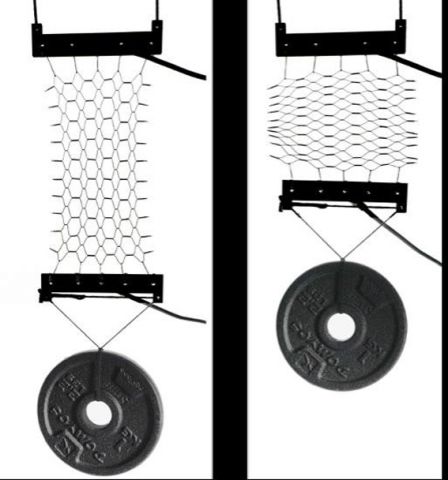
The researchers report that a 4.5-g piece of the fabric, woven from fibres of a nickel–titanium shape-memory alloy (SMA), can be stretched to 160% and contract by 50% when heated while lifting an object of 1 kg in weight. They believe that the fabric could prove useful in the development of compact wearables that provide physical assistance to those that need it.
The use of SMA fibres to produce textiles has been limited. In standard knits or weaves, the fibres loop around each other in different directions. When they contract, the forces they generate often pull against one another, partially cancelling one another out. To solve this limitation, the EPFL team developed an X-Crossing architecture. In this design, every fibre crossing is aligned precisely in the direction of the desired movement. Instead of the fibres fighting each other, they cooperate seamlessly. In addition to maximising generated force, this alignment enables the resulting fabric to be highly elastic, making garments made from it flexible and easy to put on.
A PhD student at EPFL, Huapeng Zhang, says: “We realised that the orientation of fibre crossings plays a critical role in how forces add-up inside a textile actuator. By aligning the crossings, we ensure that the forces generated at each intersection contribute constructively, rather than working against each other, resulting in a textile actuator that significantly outperforms previous knitted or knotted designs.”
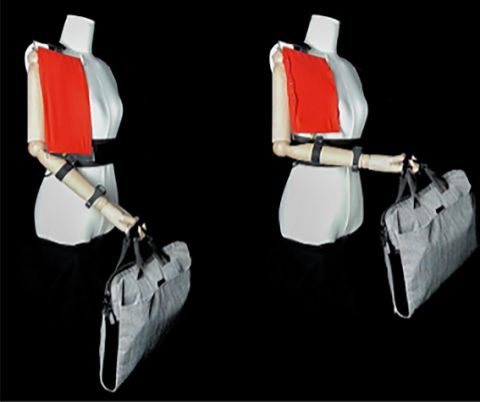
To demonstrate the potential of their X-Crossing actuators, the team integrated them into two functional wearable prototypes. First, by mounting the textile on a mannequin’s arm, they demonstrated a wearable sleeve that assists its wearer to bend their elbow. The actuator lifted a 1-kg bag held in the mannequin’s hand through a 30° range of motion in a smooth, controlled manner. In a second demonstration, the actuators were successfully used for on-body compression, which is needed for medical sleeves and athletic gear.
Beyond the new architecture itself, the researchers also developed a model that simulates how the stiffness of SMA fibres changes in response to temperature and stress. Unlike previous simplified approaches, the model accounts for spatial stiffness variations within each fibre as it undergoes phase transitions, allowing researchers to predict how much force and contraction an actuator will produce depending on loads, temperatures and its architecture.