
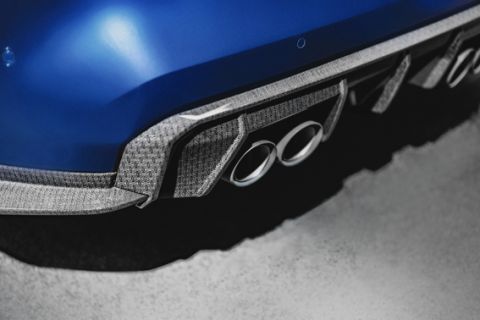
Bcomp, a Fribourg, Switzerland-based developer of flax-based technical fabrics, says that the use of its materials enables the production of composites that possess the strength and stiffness of carbon fibre-reinforced plastics (CFRPs), but have a significantly smaller carbon footprint. The manufacture of the roof of BMW’s M3 from flax fibre-reinforced composites, rather than CFRPs, reduces the carbon dioxide equivalent (CO2e) generated during the production of the part by 40%.
Bcomp and BMW Group, of Munich, Germany, have developed a bespoke natural colour and weave for the flax fabrics that they will use that meets the stringent demands for roof structures. The roof for the M3 will be made using a fully automated resin-transfer moulding (RTM) process. Other interior and exterior parts will be made using a prepreg process.
The partners tested more than one hundred materials until a combination was found that was robust enough to meet all of the requirements for automotive exterior parts. To meet large-scale demand and BMW Group’s production standards, Bcomp has built a facility for the manufacture of the parts. This facility and its already-planned expansion will ensure manufacturers have access to a reliable, scalable supply-chain for flax fibre-reinforced composites.
Bcomp's ampliTex flax-based technical fabrics can be enhanced by its powerRibs reinforcements, which comprise flax fibres woven in a grid structure. Bcomp says that flax fibre-reinforced composites are cheaper to produce than CFRPs, can demonstrate better vibration-damping properties, and are not prone to brittle fracture and splintering when they break. Once the composite parts are no longer needed, they can be recycled or used to generate energy in incineration plants.
For a number of years, Bcomp and the BMW Group have worked closely together to research and develop parts made from natural fibre-reinforced composites, and to prove their performance in motorsports environments, and have now succeeded in making them ready for series production. In 2019, Bcomp and BMW Motorsport pioneered the use of flax-fibre composites in Formula E by using ampliTex and powerRibs to build a high-performance cooling shaft for the iFE.20 race car. The 2022 BMW M4 GT4 brought the partners closer to the road, featuring more natural fibre-reinforced plastic parts than any GT race car to date.
The partnership between the two companies has been further strengthened by BMW i Ventures' investment in Bcomp’s funding in 2022 (Series B)(2) and 2024 (Series C).
Since 1998, the Paris, France-based JEC Group's Innovation Awards have attracted more than 2200 participants; 269 companies and 811 partners have been presented with awards.