
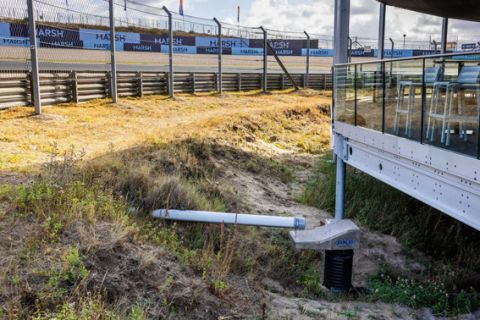
Working with TU Berlin in Germany, the FIA, of Paris, France, installed GKD's Capturion system on Tarzanbocht, the famous, tight first corner at Circuit Zandvoort in The Netherlands, for the Formula 1 Grand Prix, which took place at the circuit on 22–24 August 2026.
Capturion features a precision-woven stainless-steel filter element. Rainwater flows in a controlled manner through the filter, which retains solid particles and microplastics as floating, suspended and sedimented particles. The cleaned water is then discharged. The system can be retrofitted easily into street drains with a 500 × 500-mm square cover.
At Tarzanbocht, there is neither a classic curbside gutter nor drain covers; rainwater leaves the corner through a simple pipe. To install its Capturion filter system there, GKD developed a special filter system with an inlet unit. TU Berlin is currently evaluating the samples gathered from the filter system.
The FIA is running a research project to determine how tyre particles, and other fine particles of different sizes, shapes and densities found on racetracks and roads, can be captured before rainwater can carry them into the environment. Tyre wear is a significant source of microplastics; around 500 kt of tyre particles enter the natural environment in the European Union (EU) every year. In Germany, according to the Allgemeiner Deutscher Automobil-Club (ADAC), tyre wear accounts for about one-third of all microplastic emissions.
For one year, TU Berlin, together with GKD, studied Circuit Zandvoort, examined the soil conditions there and took samples. Based on this, the filter system was adapted to the specific conditions of the racetrack.
TU Berlin has tested Capturion on street-sweepings according to specifications laid-out by the German Institute for Building Technology (DIBt). The filter system retains 97.3% of filterable substances and 77.2% of fine substances below 63 µm. The performance of the filter has been tested in real-world conditions through a pilot project in Copenhagen, Denmark, carried-out with the Audi Environmental Foundation. In Düren, Germany, four filters have been in all-season operation since 2025.
On the racetrack, the Key Market Manager Water Filtration & Separation at GKD, Dr. Daniel Venghaus, expects different conditions. He says: “The evaluation will be exciting. The particle matrix on a racetrack probably differs significantly from that in the city, and what we learn from this will feed back into further development for the special requirements of racetracks.”
After TU Berlin has evaluated the results, the FIA intends to discuss the technology with other racetrack operators. According to statements by the FIA, there is already interest, particularly for street circuits, since the filters could be left in place for everyday road traffic.