
Based in Ansan, South Korea, Unichem is an established supplier of automotive interior materials and has agreed to acquire Loomia, of Brooklyn, New York, USA, through a transaction valued at up to US$6.3 million.
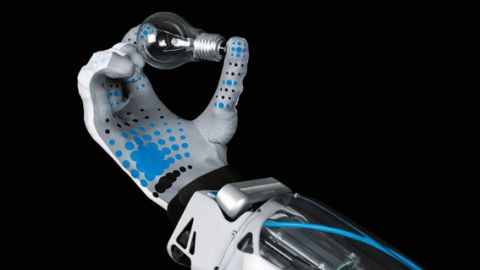
The deal follows Loomia’s work with Chinese automotive technology and manufacturing group R&Y, of Changzhou, to develop a flexible tactile sensor that can detect both vertical pressure and shear forces. Such multi-directional sensing could be an enabling technology for humanoid robotic hands and grippers; in these systems, the detection of pressure alone provides only limited information about how securely an object is being held. Loomia and R&Y are planning to create the first version of the sensor in January 2027, with Tesla Optimus, OpenAI, Boston Dynamics, 1X and Meta among the global robotics and artificial intelligence (AI) companies identified as potential customers for the technology.
Founded by Madison Maxey, Loomia has developed a method for producing ultra-thin flexible circuits, called Loomia Electronic Layers (LELs), which can be integrated into textiles, leather and other flexible materials. Rather than relying on conventional printed conductive tracks, the technology employs a low-resistance mesh construction that retains its electrical performance after repeated bending. LELs can perform multiple functions, acting as heating elements or pressure sensors, are flexible and can be attached to textiles using such as heat-bonding processes, adhesives or sewing.
Loomia recently developed a 131-point tactile-sensing system for a pneumatic robotic hand, and the company is also a member of the US National Science Foundation (NSF)-supported HAND Engineering Research Center, which is investigating technologies for dexterous robotic and human augmentation systems.
Loomia's work with R&Y could enable robotic systems to obtain more detailed information about items with which they are in physical contact, including whether an object is beginning to slip from a robotic hand; feedback that is fundamental to the fine manipulation that humans perform largely without conscious thought. The two companies have established a strategic cooperation agreement covering the development and eventual mass-production of tactile sensing technology. For Unichem, the acquisition of Loomia therefore provides a route into both robotics and electronically functional automotive surfaces.
Unichem plans to use LELs to develop smart vehicle seats and door trims that incorporate functions including heating, pressure sensing and touch input. Loomia has already been selected to supply next-generation seat-heating technology for a vehicle within the Volkswagen Group through Italian automotive seating specialist Sabelt. Unichem believes its manufacturing infrastructure in South Korea could provide additional capacity for the high-volume manufacture of such technologies.
The acquisition is expected to be completed through a reverse triangular merger involving a newly established Unichem subsidiary. Maxey and Unichem Chief Strategy Officer Kim Han-joo are expected to become co-Chief Executive Officers (CEOs) of the new subsidiary, and Loomia’s key engineering team will be retained.