
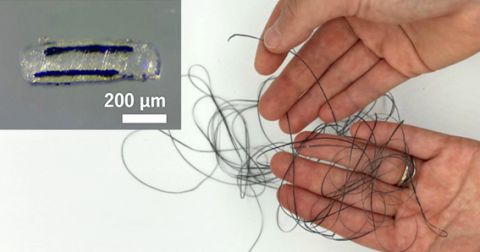
Soft actuators – materials that convert electrical energy into motion – are used in soft robotics, medical devices and wearable assistive systems. Many conventional actuators, however, rely on metals such as shape-memory alloys in order to function. Such alloys are often relatively stiff, provide limited degrees of movement and typically must be activated using heat or magnetic fields.
To overcome these challenges, an international research team from Tohoku University, in Sendai, Japan, together with researchers from INSA Lyon in France and the ELyTMaX Japan–France Joint Laboratory, are developing a polymer-based fibre actuator.
The team has adapted a thermal-drawing technique to produce a fibre made from thermoplastic polyurethane (TPU), a highly flexible material that can function as a dielectric elastomer (meaning that it deforms when an electric field is applied). The resulting fibres respond to voltage by bending, contracting and generating undulating movements in three dimensions. Associate Professor at Tohoku University, Yuanyuan Guo, says: "By combining fibre-manufacturing techniques with soft electroactive materials, we were able to create one of the thinnest and softest electrically driven actuators reported in fibre form. Because the actuator behaves like a thread, it can be easily integrated into textiles and flexible structures."
Unlike flat or bulky actuators, the fibre can be wound into spirals, knitted into fabrics and woven into complex 3D structures. This allows the actuator to generate motions that are difficult to achieve using conventional planar systems, while possessing a soft, rubber-like feel suitable for direct contact with the human body.
The researchers now plan to improve the actuator's performance by refining its internal structure and optimising the electrode materials they use. They also aim to integrate additional capabilities - such as sensing functions and fluidic channels - into the same types of fibre. Ultimately, the team hopes to develop multifunctional fibres that can both sense their environment and move in response.