
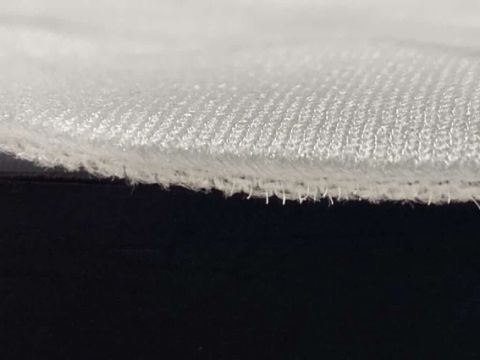
Developed by researchers at North Carolina State University (NCSU), in Raleigh, USA, and called Plant Armor, the fabric's three-layer, knitted structure prevents insects from reaching the plants it covers, but allows sunlight, rain and air to pass through it, ensuring the plants remain healthy. The researchers claim that the fabric could also reduce the need for plants to be watered.
In recent testing, the NCSU researchers found that Plant Armor increased strawberry yields by as much as 3.56 times. A graduate research assistant at the university, Gabriel Olawuyi, says: “To produce fruit, plants need sunlight. We expected that Plant Armor’s seemingly opaque fabric would lead to an increase in vegetative biomass at the expense of fruiting, because reduced sunlight would trigger a ‘shade-avoidance’ response, making the plant divert energy toward stem and leaf growth rather than fruit production. However, we found the fabric did not impede access to light at all, and fruit production increased significantly.”
Plant Armor also provided a consistent warming effect over the three seasons that the plants grow, which helped them reach the fruiting stage earlier than those without the cover. “Plants require a certain amount of accumulated heat, calculated as ‘growing degree-days’, to progress through developmental stages including fruiting. Our plant cover has proven to enhance these,” Olawuyi adds. “The plants were in a condition whereby the warmth they need to go through each phenological stage to their production was given to them optimally and they produced far more than the uncovered plants.”
Traditional fabrics for crop-protection create a barrier to insects based on their size alone, but do not offer a great deal of protection from small insects, such as tobacco thrips (which can be 0.5 mm in size). The pore-size of the outer layers of Plant Armour excludes some insects, while the inner layer is constructed in such a way as to create a "torturous path" that small insects find difficult to navigate.
Plant Armor Generation (Gen) 1 features two outer layers made from a 166-dtex (150-denier) dull, polyester (PES) multifilament, while the inner layer is made from a 22.2-dtex (20-denier) PES monofilament. The fabric is knitted on a MiniTronic 800 warp-knitting machine from Rius-Comatex of Barcelona, Spain. The outer layers of Plant Armor Gen 2, which was used to cover the strawberry plants in this latest research, are constructed from a 77.7-dtex (70-denier) bright PES multifilament containing a small amount of titanium dioxide (TiO2), while the inner layer is made of 10-dtex (9-denier) PES monofilament. The addition of TiO2 to the outer layers protects the filaments from environmental degradation. Plant Armor Gen 2 is constructed on a Jacquard OVJA 106 E 3 wt weft knitting spacer machine from Mayer & Cie of Albstadt, Germany.
Plant Armor was created as a spinoff of efforts to make military uniforms resistant to mosquito bites and more comfortable when worn under body armour. A Distinguished Professor at NCSU, R. Michael Roe, concludes: “Through trial and error, we arrived at a product which could triple the output of strawberry farms here in North Carolina. We could not have predicted that when we started. Without all these people here doing research and following the science, we would not have arrived at this product.”