
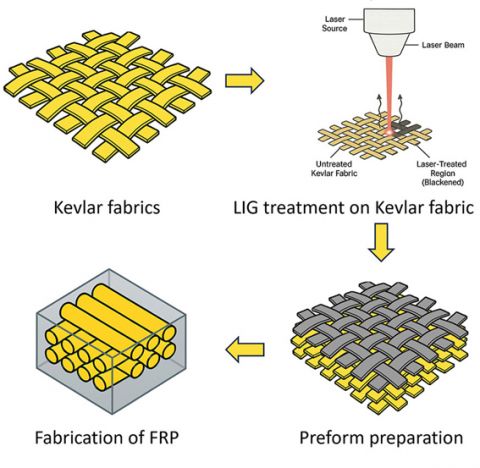
The researchers say that traditional composites demonstrate a high strength-to-weight ratio and are typically used only as structural materials. Creating composites that have multiple functions usually requires the use of additional components that increase their weight or the complexity of the processes used for their manufacture. To overcome these issues, the IMDEA researchers have developed a technique that enables laser-induced graphene (LIG) to be created directly on para-aramid fabrics that can then be incorporated into composites using a scalable manufacturing process.
The researchers take a 2/2 twill-woven fabric with an areal density of 170 g.m-2 (manufactured by C. Cramer & Co GmbH, of Heek, and purchased from R&G Faserverbundwerkstoffe GmbH, of Waldenbuch, both in Germany), and carbonise its surface using a laser to create LIG, which demonstrates electrical and thermal conductivity, and piezoresistivity. By creating LIG in-situ, the researchers say that they have eliminated the need for the additional substrates, adhesive layers or transfer processes typically required to incorporate LIG into composites.
The modified para-aramid fabric can be integrated into laminates made from a bio-based epoxy and a basalt-fibre reinforcement using a vacuum-infusion process commonly used for the manufacture of composites. The laser modification of the fabric does not compromise the structural integrity of the composite. Further, the piezoresistive response of the fabric enables the deformation of the composite to be monitored and, through Joule heating, the fabric can reach temperatures of above 50°C when low voltages are applied to it, enabling it to melt ice at -40 °C within five minutes.
The researchers now plan to optimise the resin-infusion process that they use. They also say that they need to solve two other problems: the electromechanical stability of the electrical contacts they currently use can fail under high-cycle mechanical fatigue; repeated cycles of Joule heating can degrade the composite's epoxy matrix.