
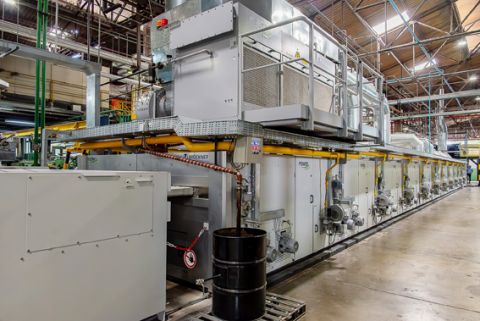
Brückner, of Leonberg, Germany, sayS that the stenter, which was installed at Cedro Têxtil's facility in Sete Lagoas, Brazil, one year ago, has reduced natural-gas consumption at the site by more than 20%, while significantly increasing production speeds there. The uniform distribution of temperature throughout the dryer ensures the dimensional stability of even highly elastic fabrics, guaranteeing the quality of the finished product. The productivity gains were so substantial that, following the commissioning of the new line, Cedro Têxtil was able to decommission three older stenter frames. This has significantly reduced the company's operating costs and optimised its production processes.
Based in Belo Horizonte, Brazil, Cedro Têxtil was looking for a stenter frame that would enable it to manufacture high-quality fabrics, support its environmental sustainability goals and deliver long-term economic benefits. Its purchase of the Brückner stenter frame was preceded by an extensive selection process. Over several years, Cedro Têxtil evaluated machines from leading European and Asian manufacturers, visited their production facilities and reference customers around the world, and compared a wide range of technologies. The company benchmarked its options for productivity, maintenance costs, technical support, energy efficiency, spare parts availability and local service in Brazil.
Cedro Têxtil's successful commissioning of its first Brückner line may be only the beginning of the relationship between the two companies. Cedro Têxtil plans to replace additional existing production lines with Brückner lines in the future.
The Industrial Director of Cedro Têxtil, Patrick Melo Pinheiro, says: “Whether currency fluctuations, world wars, or the recent pandemic, we have always viewed every challenge as an opportunity to become stronger. By investing in a Brückner production line, we have taken an important step towards a more sustainable future and significantly reduced our carbon footprint.”
Cedro Têxtil has reduced its greenhouse-gas emissions by an impressive 85% over recent years. Its investment in Brückner's energy-efficient technology supports this commitment and strengthens the company’s competitiveness in a market where customers increasingly value sustainable manufacturing processes and environmentally responsible supply chains.
Workwear fabrics account for approximately 65% of Cedro Têxtil’s output. The finished fabrics are used in industries including manufacturing, healthcare, military applications and personal protective equipment (PPE). The company produces more than 60 million linear metres of fabric a year, generates annual revenues of approximately BRL1.2 billion, and employs more than 2600 people.