
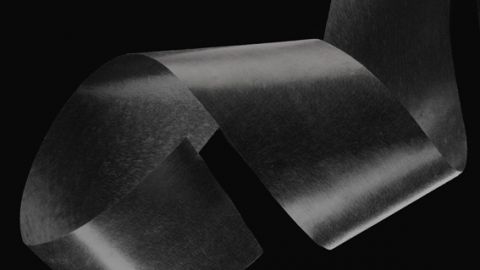
The company says that, while techniques that allow short or recycled fibres to be aligned in nonwovens have been demonstrated at laboratory- and pilot-scale, producing such fabrics in commercially viable production widths, areal densities and volumes has proven difficult.
Using its method, called Vectis, James Cropper has manufactured an aligned nonwoven fibre mat (Unimat) designed to be impregnated or combined with resins in composite-manufacturing processes. The company says that Unimat delivers directional mechanical performance, while retaining the formability required for the manufacture of composite parts with comlicated geometries. It is supplied as a non-impregnated material and can be processed using existingprocesses, including prepreg layup, compression moulding, stamping, resin-transfer moulding (RTM) and autoclave processing.
The Vectis method can be carried out on James Cropper’s existing industrial machinery for the production of nonwovens, enabling the high-volume production of fabrics odf widths of up to 1200 mm and areal densities from 20–200 g.m–². Almost 95% of the fibres in Unimat are alligned in the same direction and it can be manufactured from recycled carbon fibre, post-industrial waste, virgin carbon fibre, glass fibre and hybrid blends. It is suitable for use by manufacturers serving the aerospace, automotive and sporting goods industries looking to balance mechanical performance, process efficiency environmental sustainability.
The Head of Sales at James Cropper, Tom Sharrock, says: “Alignment of discontinuous fibres has been demonstrated many times at a small scale, but industrialisation has been the missing piece. Vectis changes that by enabling aligned nonwoven materials to be manufactured at an industrial scale that can realistically support commercial composite programmes, with Unimat demonstrating what that capability can deliver.”
The Innovation Director at James Cropper, Mandy Clement, concludes: “This technology has been more than a decade in the making. By bringing together deep expertise in fibre behaviour with proven nonwoven manufacturing know-how, we have created a platform that opens new possibilities for aligned composite materials across multiple sectors.”